Stanford HAI Launches Graduate Fellowship Program, Names 16 to First Cohort
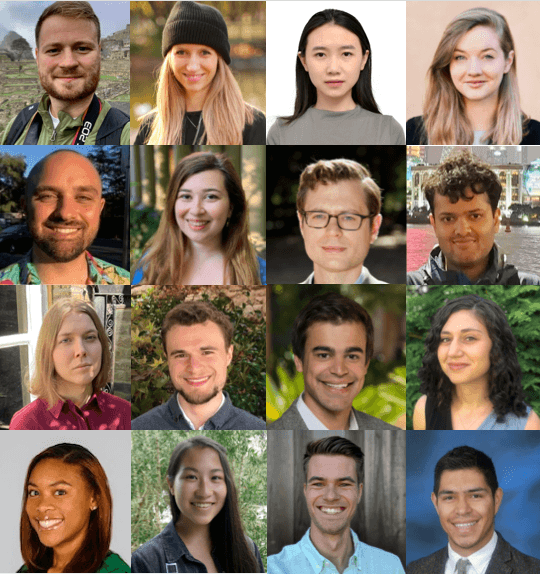
In this pilot program, graduate students will work across disciplines on projects advancing a human-centered approach to the science of AI and its societal impacts.
The Stanford Institute for Human-Centered AI has named an inaugural cohort of 16 graduate students to a new fellowship program that offers an opportunity to join HAI scholars in their work to guide and build the future of AI.
The Stanford HAI Graduate Fellowship Program is specifically designed to promote interdisciplinary research on human-centered AI, foster new connections between fellows and PIs, and grow the HAI community of scholars.
“These students come from an extraordinary range of disciplines and will bring with them the divergent perspectives that are so critical to our research mission here at HAI,” said John Etchemendy, Patrick Suppes Family Professor in the School of Humanities and Sciences and Denning Co-Director, Stanford HAI. “AI is transforming every aspect of our world, and it’s crucial that our future leaders — those working on the frontiers of science, humanities, law, the arts, and more — have the opportunity to both learn from and contribute to the development of human-centered AI.”
The two-quarter pilot program will begin in fall 2021. Fellows will
Organize and participate in bi-weekly seminars and workshops with HAI-affiliated faculty, guest speakers, and fellow cohort members.
Collaborate with a fellow from a different discipline on a small project based on their interests.
Engage in the participatory design of the program, with the goal of helping HAI turn the pilot into a rigorous program that provides impact throughout the university.
“I’m excited about the ways in which these graduate fellows will enrich our research and our community,” said Fei-Fei Li, Sequoia Professor, Computer Science Department; Denning Co-Director, Stanford HAI.
Meet the 2021-2022 HAI graduate fellows:
AJ Alvero, Graduate School of Education
AJ Alvero is a doctoral student studying data science, inequality/inequity in education, and computational sociolinguistics. He is a co-founder of the Student Narrative Lab.
Victoria Delaney, School of Education
Doctoral student Victoria Delaney studies mathematics education, computer science, and the learning sciences. She’s interested in exploring how technology can be used to improve pedagogy and learning experiences in advanced mathematics and computer science.
Jacqueline Harding, Philosophy
Jacqueline Harding is a doctoral student studying the application of ideas from the philosophy of science to guide the development of explainable AI.
Ayush Kanodia, Computer Science
Ayush Kanodia is a doctoral student focused on machine learning applied to economic structural modeling and causal inference, recommendation systems, and experiment design.
Michelle Lam, Computer Science
Doctoral student Michelle Lam is interested in exploring how the negative effects of AI-powered systems might be countered by building on the lived experiences and expertise of everyday users and by applying human-centered design approaches that empower users to reshape the design of AI systems.
Ashley Lewis, School of Medicine/Biomedical Informatics
Incoming doctoral student Ashley Lewis is interested in developing machine learning algorithms that can uncover critical patterns in data and ultimately result in a deeper understanding of biological mechanisms.
Incoming doctoral student Julio Martinez is interested in working on neural systems that explain how various processes are computed in the brain, while simultaneously advancing the current state of AI.
Faidra Monachou, Management Science and Engineering
Doctoral candidate Faidra Monachou uses mathematical modeling and data-driven simulations to study socioeconomic problems and policy questions that arise in resource allocation settings and on digital platforms. Her current focus is on the role of information, discrimination, and diversity in designing fair admissions policies.
Doctoral candidate Anna Mukamal researches the relationship between psychotherapy and modern and contemporary literature.
Evan Munro, Graduate School of Business
Evan Munro, a doctoral student in economics, is interested in problems at the intersection of machine learning, econometrics, and mechanism design.
Doctoral candidate Jeff Nagy studies the long history of exchanges between computing and the behavioral sciences. His current research focuses on the historical attempts to make emotion computable from the post-WWII period to the present.
Jerome Nowak, Mechanical Engineering
Doctoral candidate Jerome Nowak studies technology’s influence on the human condition through the lenses of social philosophy and positive psychology. He is currently researching how collaboration with, and deference to, robots and other artificial agents affect our sense of self and our appreciation of human presence.
William Parish is a doctoral student in history whose research centers on questions at the intersection of spatiality and indigenous sovereignty. He is exploring how AI, virtual reality, and augmented reality might help conceptualize historical indigenous spaces and how these tools might bring indigenous views to bear on the technologies themselves.
Thomas Teisberg, Electrical Engineering
Thomas Teisberg is a doctoral student in electrical engineering whose research focuses on methods for optimizing and automating the collection of observational data about Earth’s ice sheets.
Amélie-Sophie Vavrovsky, International Policy and E-IPR
Amélie-Sophie Vavrovsky is a dual-degree graduate student in cyber policy and sustainable design and a fellow at the Stanford Center for Legal Informatics (CodeX), where she leads technology projects that seek to make legal processes fairer and more accessible. Her research at HAI will focus on how automated decision processes impact human rights, including questions of bias, access to justice through legal technology, and data equity.
Doctoral student Lu Yang researches the use of machine learning and artificial intelligence in clinical and genomic diagnostics.
Learn more about Stanford HAI fellowship programs.
Related News

Dashboards created by Stanford HAI’s Digital Economy Lab measure how AI adoption is altering employment trends and job growth, along with broader economic indicators.

Dashboards created by Stanford HAI’s Digital Economy Lab measure how AI adoption is altering employment trends and job growth, along with broader economic indicators.

Over three years, we’ve built progressively harder, more realistic benchmarks for medical AI. Here’s what we learned.

Over three years, we’ve built progressively harder, more realistic benchmarks for medical AI. Here’s what we learned.
It's one of AI policy's hardest unsolved problems. Expert Deb Raji joins Stanford HAI to find answers that move beyond principles and into practice.
It's one of AI policy's hardest unsolved problems. Expert Deb Raji joins Stanford HAI to find answers that move beyond principles and into practice.