Regulation, Policy, Governance
How policymakers can best regulate AI to balance innovation with public interests and human rights.
Daniel Zhang, Caroline Meinhardt, Jiajun Wu, and Russell Wald | The World Model and Spatial Intelligence Era: Governing AI Beyond Language
As AI moves beyond language into systems that can perceive, understand, and act in the physical world, a new frontier is emerging: world models—AI systems that build and maintain working representations of real environments to predict how they change in response to action.
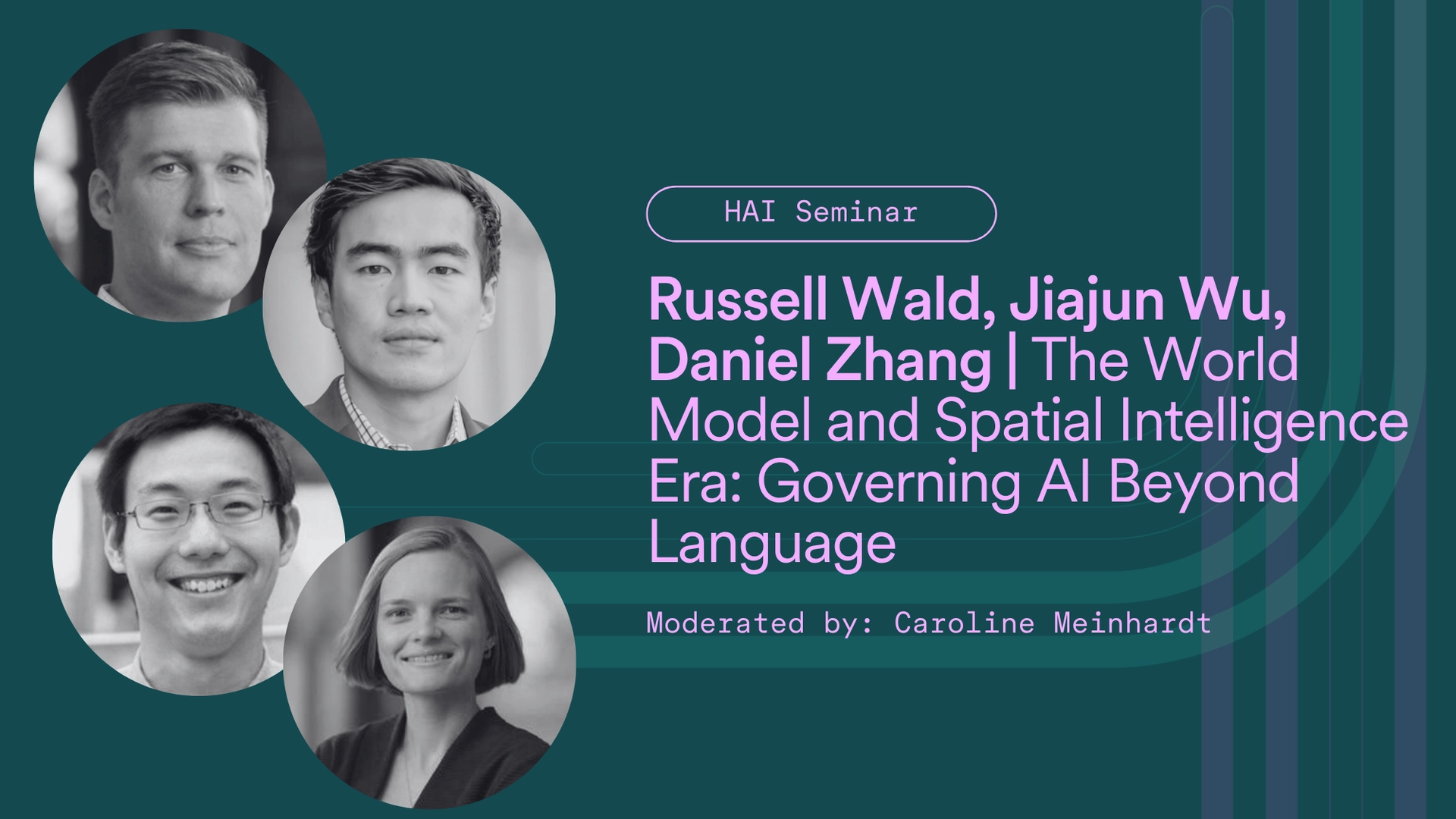
As AI moves beyond language into systems that can perceive, understand, and act in the physical world, a new frontier is emerging: world models—AI systems that build and maintain working representations of real environments to predict how they change in response to action.
HAI Denning Director James Landay responds to the latest round of AI doomerism and how policymakers should respond to it.
HAI Denning Director James Landay responds to the latest round of AI doomerism and how policymakers should respond to it.
In January 2026, Utah announced a first-of-its kind pilot program allowing an autonomous artificial intelligence (AI) agent to renew prescriptions for consumers who request it. The state agreed not to enforce its unprofessional conduct laws against the developer, Doctronic, if the company adheres to a contract that includes safety and privacy protections. The pilot program includes 192 drugs for chronic conditions. Although physicians will initially validate the AI’s actions, the pilot program will swiftly become one of the first deployments at scale of an autonomous, agentic system in medicine. The announcement prompted concern from associations of physicians and pharmacists who opined that AI “should NOT be making care decisions.”
In January 2026, Utah announced a first-of-its kind pilot program allowing an autonomous artificial intelligence (AI) agent to renew prescriptions for consumers who request it. The state agreed not to enforce its unprofessional conduct laws against the developer, Doctronic, if the company adheres to a contract that includes safety and privacy protections. The pilot program includes 192 drugs for chronic conditions. Although physicians will initially validate the AI’s actions, the pilot program will swiftly become one of the first deployments at scale of an autonomous, agentic system in medicine. The announcement prompted concern from associations of physicians and pharmacists who opined that AI “should NOT be making care decisions.”
We welcome proposals for research projects that tackle important challenges and opportunities in this space from either a technical or social science perspective, with findings that can generate policy insights and recommendations.
Policy Research Grants
We welcome proposals for research projects that tackle important challenges and opportunities in this space from either a technical or social science perspective, with findings that can generate policy insights and recommendations.
Designing Loyalty: AI Agents and Conflicts of Interest
This brief examines the conflict-of-interest risks posed by AI agents and calls for imposing a duty of loyalty on developers and deployers.
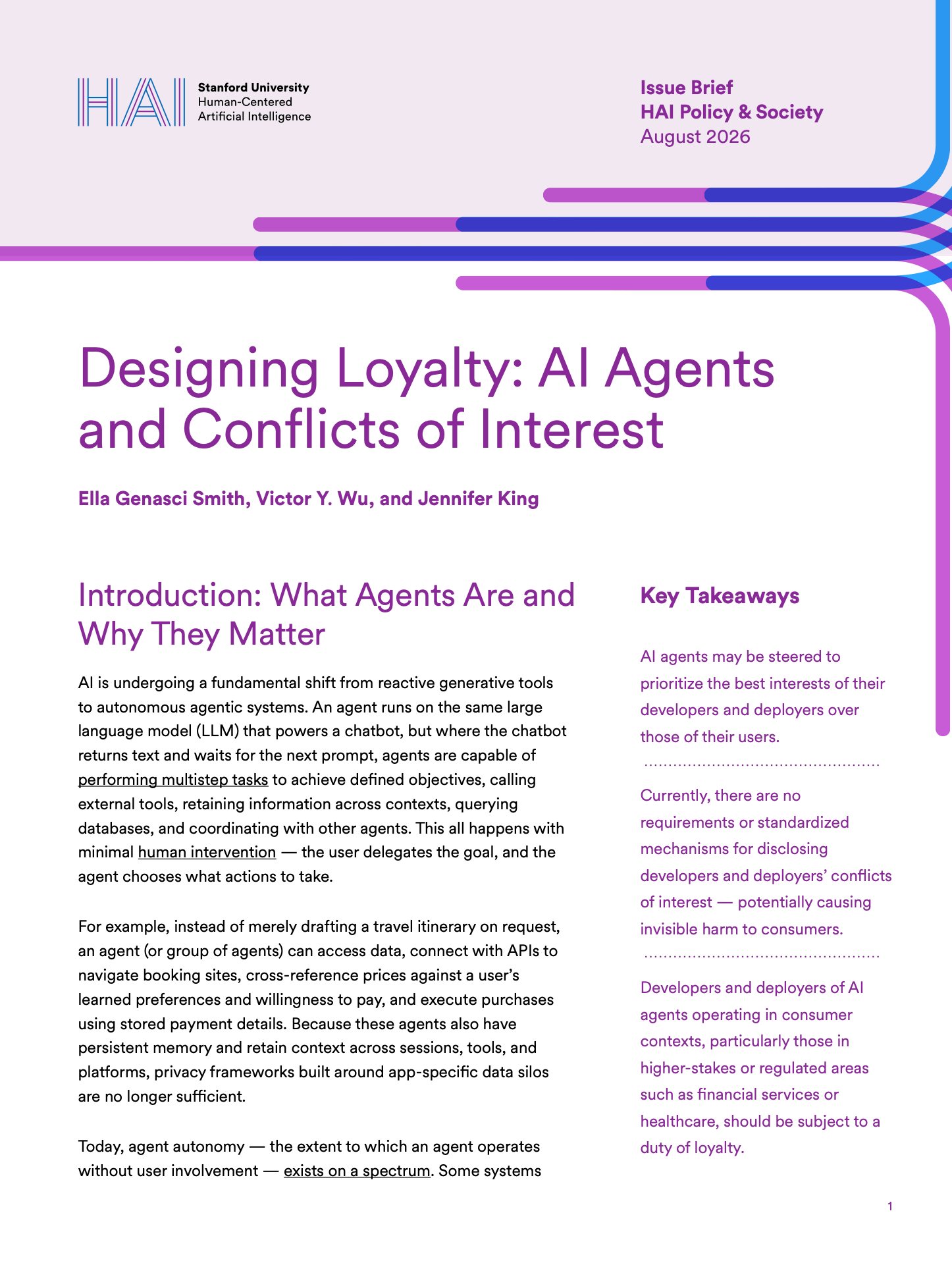
This brief examines the conflict-of-interest risks posed by AI agents and calls for imposing a duty of loyalty on developers and deployers.
All Work Published on Regulation, Policy, Governance
HAI Policy Fellow Riana Pfefferkorn comments on recent federal appeals court asking the Supreme Court to reconsider laws around AI generated CSAM.
HAI Policy Fellow Riana Pfefferkorn comments on recent federal appeals court asking the Supreme Court to reconsider laws around AI generated CSAM.
The AI Arms Race In Health Insurance Utilization Review: Promises Of Efficiency And Risks Of Supercharged Flaws
Health insurers and health care provider organizations are increasingly using artificial intelligence (AI) tools in prior authorization and claims processes. AI offers many potential benefits, but its adoption has raised concerns about the role of the “humans in the loop,” users’ understanding of AI, opacity of algorithmic determinations, underperformance in certain tasks, automation bias, and unintended social consequences. To date, institutional governance by insurers and providers has not fully met the challenge of ensuring responsible use. However, several steps could be taken to help realize the benefits of AI use while minimizing risks. Drawing on empirical work on AI use and our own ethical assessments of provider-facing tools as part of the AI governance process at Stanford Health Care, we examine why utilization review has attracted so much AI innovation and why it is challenging to ensure responsible use of AI. We conclude with several steps that could be taken to help realize the benefits of AI use while minimizing risks.
Health insurers and health care provider organizations are increasingly using artificial intelligence (AI) tools in prior authorization and claims processes. AI offers many potential benefits, but its adoption has raised concerns about the role of the “humans in the loop,” users’ understanding of AI, opacity of algorithmic determinations, underperformance in certain tasks, automation bias, and unintended social consequences. To date, institutional governance by insurers and providers has not fully met the challenge of ensuring responsible use. However, several steps could be taken to help realize the benefits of AI use while minimizing risks. Drawing on empirical work on AI use and our own ethical assessments of provider-facing tools as part of the AI governance process at Stanford Health Care, we examine why utilization review has attracted so much AI innovation and why it is challenging to ensure responsible use of AI. We conclude with several steps that could be taken to help realize the benefits of AI use while minimizing risks.
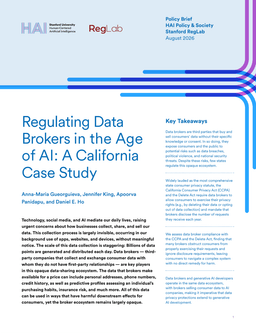
Regulating Data Brokers in the Age of AI: A California Case Study
This brief assesses data broker compliance with California privacy laws and calls for more stringent consumer protections.
This brief assesses data broker compliance with California privacy laws and calls for more stringent consumer protections.
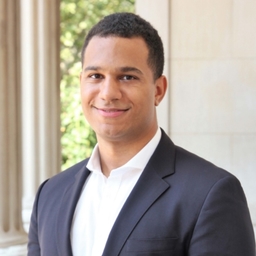
Julian Nyarko


Building an AI pipeline to comb through millions of local statutes, researchers at Stanford Law School turn a spotlight on unsavory laws still on the books in communities across the country.
Building an AI pipeline to comb through millions of local statutes, researchers at Stanford Law School turn a spotlight on unsavory laws still on the books in communities across the country.