All Related
On the Societal Impact of Open Foundation Models

New research adds precision to the debate on openness in AI.
New research adds precision to the debate on openness in AI.


The U.S. government has made swift progress and broadened transparency, but that momentum needs to be maintained for the next looming deadlines.
The U.S. government has made swift progress and broadened transparency, but that momentum needs to be maintained for the next looming deadlines.

Daniel E. Ho's Testimony Before the California Senate Governmental Organization Committee and the Senate Budget and Fiscal Review Subcommittee No. 4 on State Administration and General Government

In this testimony presented in the California Senate Hearing “California at the Forefront: Steering AI Towards Ethical Horizons,” Daniel E. Ho offers three recommendations for how California should lead the nation in responsible AI innovation by nurturing and attracting technical talent into public service, democratizing access to computing and data resources, and addressing the information asymmetry about AI risks.
In this testimony presented in the California Senate Hearing “California at the Forefront: Steering AI Towards Ethical Horizons,” Daniel E. Ho offers three recommendations for how California should lead the nation in responsible AI innovation by nurturing and attracting technical talent into public service, democratizing access to computing and data resources, and addressing the information asymmetry about AI risks.


A new study finds that large language models used widely for medical assessments cannot back up claims.
A new study finds that large language models used widely for medical assessments cannot back up claims.

Hallucinating Law: Legal Mistakes with Large Language Models are Pervasive

A new study finds disturbing and pervasive errors among three popular models on a wide range of legal tasks.
A new study finds disturbing and pervasive errors among three popular models on a wide range of legal tasks.


This brief highlights the benefits of open foundation models and calls for greater focus on their marginal risks.
This brief highlights the benefits of open foundation models and calls for greater focus on their marginal risks.

Responses to OMB's Request for Comment on Draft Policy Guidance on Agency Use of AI

Stanford scholars respond to a federal RFC on the Office of Management and Budget’s (OMB) draft policy guidance on advancing governance, innovation, and risk management for agency use of AI.
Stanford scholars respond to a federal RFC on the Office of Management and Budget’s (OMB) draft policy guidance on advancing governance, innovation, and risk management for agency use of AI.


New Stanford tracker analyzes the 150 requirements of the White House Executive Order on AI and offers new insights into government priorities.
New Stanford tracker analyzes the 150 requirements of the White House Executive Order on AI and offers new insights into government priorities.


This brief sheds light on the “regulatory misalignment” problem by considering the technical and institutional feasibility of four commonly proposed AI regulatory regimes.
This brief sheds light on the “regulatory misalignment” problem by considering the technical and institutional feasibility of four commonly proposed AI regulatory regimes.


America is ready again to lead on AI—and it won’t just be American companies shaping the AI landscape if the White House has anything to say about it.
America is ready again to lead on AI—and it won’t just be American companies shaping the AI landscape if the White House has anything to say about it.

The Privacy-Bias Trade-Off

This brief examines the “regulatory misalignment” of existing regulatory proposals for AI and urges policymakers to first consider feasibility, trade-offs, and unintended consequences before rushing into regulation.
This brief examines the “regulatory misalignment” of existing regulatory proposals for AI and urges policymakers to first consider feasibility, trade-offs, and unintended consequences before rushing into regulation.

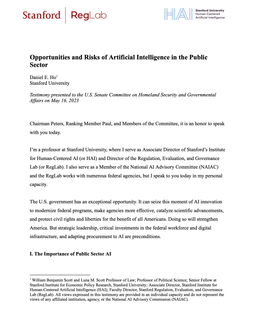
Daniel E. Ho's Testimony Before the Senate Committee on Homeland Security and Governmental Affairs
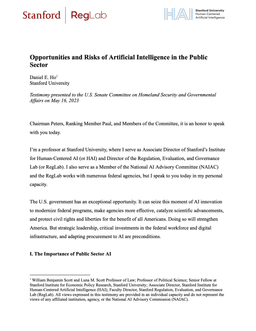
In this testimony presented to the U.S. Senate Committee on Homeland Security and Governmental Affairs, Daniel E. Ho calls for Congress to seize AI’s potential to modernize federal programs and protect civil rights to maintain American leadership in AI innovation and responsible AI.
In this testimony presented to the U.S. Senate Committee on Homeland Security and Governmental Affairs, Daniel E. Ho calls for Congress to seize AI’s potential to modernize federal programs and protect civil rights to maintain American leadership in AI innovation and responsible AI.