Upcoming Events
Alexandr Lenk & Arvind Karunakaran | Industry Conversation with Instacart
This seminar pairs a case study of AI diffusion with an organizational approach to technological changes in the workplace.
Alexandr Lenk & Arvind Karunakaran | Industry Conversation with Instacart
This seminar pairs a case study of AI diffusion with an organizational approach to technological changes in the workplace.
Marlowe | AI + Data for Science with Stephen Baccus
Sessions run Wednesdays from 4:30–5:30 PM in CoDa E160. Each session features a different Stanford speaker; talk titles are announced by the organizers.
Sessions run Wednesdays from 4:30–5:30 PM in CoDa E160. Each session features a different Stanford speaker; talk titles are announced by the organizers.
World Development Report 2026: The Promise of Artificial Intelligence
World Development Report 2026: The Promise of Artificial Intelligence
Daniel Zhang, Caroline Meinhardt, Jiajun Wu, and Russell Wald | The World Model and Spatial Intelligence Era: Governing AI Beyond Language
As AI moves beyond language into systems that can perceive, understand, and act in the physical world, a new frontier is emerging: world models—AI systems that build and maintain working representations of real environments to predict how they change in response to action.
Daniel Zhang, Caroline Meinhardt, Jiajun Wu, and Russell Wald | The World Model and Spatial Intelligence Era: Governing AI Beyond Language
As AI moves beyond language into systems that can perceive, understand, and act in the physical world, a new frontier is emerging: world models—AI systems that build and maintain working representations of real environments to predict how they change in response to action.
Marlowe | AI + Data for Science with Gordon Wetzstein
Sessions run Wednesdays from 4:30–5:30 PM in CoDa E160. Each session features a different Stanford speaker; talk titles are announced by the organizers.
Sessions run Wednesdays from 4:30–5:30 PM in CoDa E160. Each session features a different Stanford speaker; talk titles are announced by the organizers.
Anastasios Angelopoulos | Measuring AI in the Real World
This seminar co-hosted with the AI Measurement Science Center (AIMS) invites speakers to discuss academic work in AI evaluation and measurement science.
Anastasios Angelopoulos | Measuring AI in the Real World
This seminar co-hosted with the AI Measurement Science Center (AIMS) invites speakers to discuss academic work in AI evaluation and measurement science.
Tim de Silva | AI Financial Advice: Supply, Demand, and Life Cycle Implications
Tim de Silva | AI Financial Advice: Supply, Demand, and Life Cycle Implications
Marlowe | AI + Data for Science with Olivier Gevaert
Sessions run Wednesdays from 4:30–5:30 PM in CoDa E160. Each session features a different Stanford speaker; talk titles are announced by the organizers.
Sessions run Wednesdays from 4:30–5:30 PM in CoDa E160. Each session features a different Stanford speaker; talk titles are announced by the organizers.
Marlowe | AI + Data for Science with Curtis Langlotz
Sessions run Wednesdays from 4:30–5:30 PM in CoDa E160. Each session features a different Stanford speaker; talk titles are announced by the organizers.
Sessions run Wednesdays from 4:30–5:30 PM in CoDa E160. Each session features a different Stanford speaker; talk titles are announced by the organizers.
Marlowe | AI + Data for Science with Anshul Kundaje
Sessions run Wednesdays from 4:30–5:30 PM in CoDa E160. Each session features a different Stanford speaker; talk titles are announced by the organizers.
Sessions run Wednesdays from 4:30–5:30 PM in CoDa E160. Each session features a different Stanford speaker; talk titles are announced by the organizers.
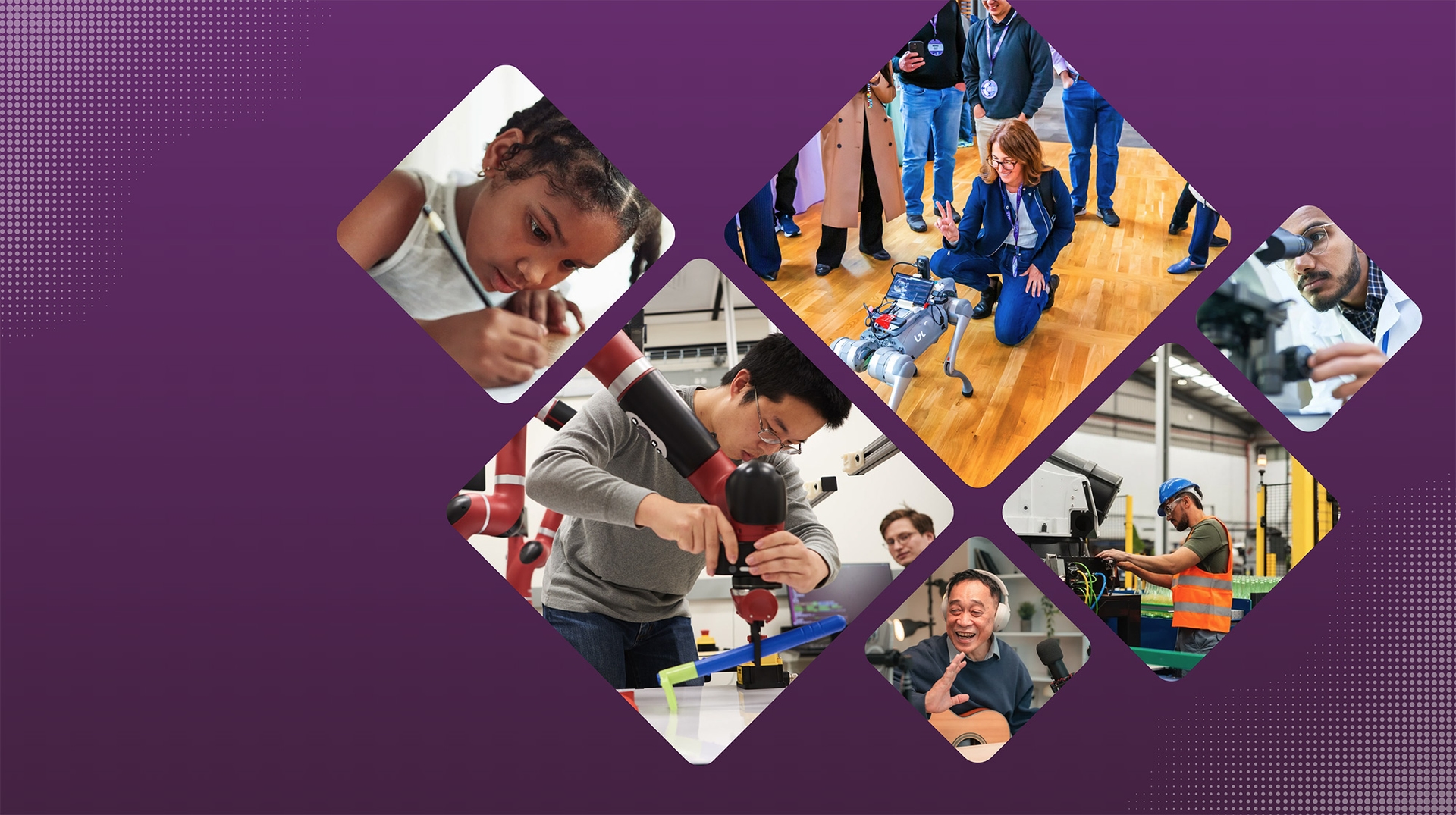
Confronting Our AI Future: Hope, Fear, and the Choices Ahead
The rapid acceleration of AI comes with a profound wave of anxiety. Across every sector of society, people are facing unsettling questions about their worth and their place in a shifting world.
Confronting Our AI Future: Hope, Fear, and the Choices Ahead
The rapid acceleration of AI comes with a profound wave of anxiety. Across every sector of society, people are facing unsettling questions about their worth and their place in a shifting world.
Marlowe | AI + Data for Science with Dan Yamins
Sessions run Wednesdays from 4:30–5:30 PM in CoDa E160. Each session features a different Stanford speaker; talk titles are announced by the organizers.
Marlowe | AI + Data for Science with Dan Yamins
Sessions run Wednesdays from 4:30–5:30 PM in CoDa E160. Each session features a different Stanford speaker; talk titles are announced by the organizers.
Marcos Santiago Rojas Pino & Thomas Caruso | Building an International AI Platform for Health Professions Education and the Learning Sciences
Clinical Mind AI is a Stanford-developed, international collaborative platform designed to strengthen clinical reasoning education through AI-simulated patient encounters across health professions.
Marcos Santiago Rojas Pino & Thomas Caruso | Building an International AI Platform for Health Professions Education and the Learning Sciences
Clinical Mind AI is a Stanford-developed, international collaborative platform designed to strengthen clinical reasoning education through AI-simulated patient encounters across health professions.
Marlowe | AI + Data for Science with Ruijiang Li
Sessions run Wednesdays from 4:30–5:30 PM in CoDa E160. Each session features a different Stanford speaker; talk titles are announced by the organizers.
Marlowe | AI + Data for Science with Ruijiang Li
Sessions run Wednesdays from 4:30–5:30 PM in CoDa E160. Each session features a different Stanford speaker; talk titles are announced by the organizers.
Marlowe | AI + Data for Science with Mohsen Bayati
Sessions run Wednesdays from 4:30–5:30 PM in CoDa E160. Each session features a different Stanford speaker; talk titles are announced by the organizers.
Sessions run Wednesdays from 4:30–5:30 PM in CoDa E160. Each session features a different Stanford speaker; talk titles are announced by the organizers.
AI100 | AI Goes Mainstream: The Scaling Era and the Rise of Generative AI
This talk will cover key insights from the third AI100 report, AI Goes Mainstream: The Scaling Era and the Rise of Generative AI, set for release in October 2026. The report was commissioned by the AI100 standing committee and led by study panel chair Michael Wooldridge.
AI100 | AI Goes Mainstream: The Scaling Era and the Rise of Generative AI
This talk will cover key insights from the third AI100 report, AI Goes Mainstream: The Scaling Era and the Rise of Generative AI, set for release in October 2026. The report was commissioned by the AI100 standing committee and led by study panel chair Michael Wooldridge.
Marlowe | AI + Data for Science with Andreas Tolias
Sessions run Wednesdays from 4:30–5:30 PM in CoDa E160. Each session features a different Stanford speaker; talk titles are announced by the organizers.
Sessions run Wednesdays from 4:30–5:30 PM in CoDa E160. Each session features a different Stanford speaker; talk titles are announced by the organizers.
Marlowe | AI + Data for Science with Leonidas Guibas
Sessions run Wednesdays from 4:30–5:30 PM in CoDa E160. Each session features a different Stanford speaker; talk titles are announced by the organizers.
Sessions run Wednesdays from 4:30–5:30 PM in CoDa E160. Each session features a different Stanford speaker; talk titles are announced by the organizers.
Angèle Christin & Hannah Zeavin | Gurus, Hucksters, Entertainers: How Influencers Reshaped Social Media
Please join us for an illuminating investigation of the complex work of social media content creators—their lives, conflicts, and controversies.
Angèle Christin & Hannah Zeavin | Gurus, Hucksters, Entertainers: How Influencers Reshaped Social Media
Please join us for an illuminating investigation of the complex work of social media content creators—their lives, conflicts, and controversies.
Featured Videos
Hear from speakers and attendees at recent Stanford HAI events across research, policy, and education.
Previous Events at HAI
HAI Weekly Seminar with David Robinson - Governing an Algorithm in the Wild
HAI Weekly Seminar with David Robinson - Governing an Algorithm in the Wild
HAI Weekly Seminar with John Markoff - Second Thoughts on Digital Utopianism
Bio: John Markoff is HAI’s Journalist-in-Residence. He is also a research affiliate at the Center for Advanced Study in the Behavioral Sciences or CASBS, participating in projects focusing on the future of work and artificial intelligence. He is currently researching a biography of Stewart Brand, the creator of the Whole Earth Catalog. Previously he was a Berggruen Fellow at CASBS. He has also been a staff historian at the Computer History Museum in Mountain View, Calif. Until 2017, he was a reporter at The New York Times, beginning in March 1988 as the paper’s national computer writer. Prior to joining the Times, he worked for the San Francisco Examiner. He has written about technology for Pacific News Service. He was a reporter at Infoworld and West Coast editor for Byte Magazine and wrote a column on personal computers for the San Jose Mercury. He has also been a lecturer at the University of California at Berkeley School of Journalism and an adjunct faculty member of the Stanford Graduate Program on Journalism. In 2013 he was awarded a Pulitzer Prize in explanatory reporting as part of a New York Times project on labor and automation. In 2007, he was named a fellow of the Society of Professional Journalists, the organization’s highest honor. In June of 2010, the New York Times presented him with the Nathaniel Nash Award, which is given annually for foreign and business reporting. He is the co-author of The High Cost of High Tech, published by Harper & Row. He co-wrote Cyberpunk: Outlaws and Hackers on the Computer Frontier published Simon & Schuster. Hyperion published Takedown: The Pursuit and Capture of America's Most Wanted Computer Outlaw, which he co-authored with Tsutomu Shimomura. What the Dormouse Said: How the Sixties Counterculture Shaped the Personal Computer Industry, was published by Viking Books. Machines of Loving Grace: The Quest for Common Ground Between Humans and Robots, was published by HarperCollins Ecco. Markoff grew up in Palo Alto, California, and graduated from Whitman College, Walla Walla, Washington. He attended graduate school at the University of Oregon and received a masters degree in sociology.
HAI Weekly Seminar with John Markoff - Second Thoughts on Digital Utopianism
Bio: John Markoff is HAI’s Journalist-in-Residence. He is also a research affiliate at the Center for Advanced Study in the Behavioral Sciences or CASBS, participating in projects focusing on the future of work and artificial intelligence. He is currently researching a biography of Stewart Brand, the creator of the Whole Earth Catalog. Previously he was a Berggruen Fellow at CASBS. He has also been a staff historian at the Computer History Museum in Mountain View, Calif. Until 2017, he was a reporter at The New York Times, beginning in March 1988 as the paper’s national computer writer. Prior to joining the Times, he worked for the San Francisco Examiner. He has written about technology for Pacific News Service. He was a reporter at Infoworld and West Coast editor for Byte Magazine and wrote a column on personal computers for the San Jose Mercury. He has also been a lecturer at the University of California at Berkeley School of Journalism and an adjunct faculty member of the Stanford Graduate Program on Journalism. In 2013 he was awarded a Pulitzer Prize in explanatory reporting as part of a New York Times project on labor and automation. In 2007, he was named a fellow of the Society of Professional Journalists, the organization’s highest honor. In June of 2010, the New York Times presented him with the Nathaniel Nash Award, which is given annually for foreign and business reporting. He is the co-author of The High Cost of High Tech, published by Harper & Row. He co-wrote Cyberpunk: Outlaws and Hackers on the Computer Frontier published Simon & Schuster. Hyperion published Takedown: The Pursuit and Capture of America's Most Wanted Computer Outlaw, which he co-authored with Tsutomu Shimomura. What the Dormouse Said: How the Sixties Counterculture Shaped the Personal Computer Industry, was published by Viking Books. Machines of Loving Grace: The Quest for Common Ground Between Humans and Robots, was published by HarperCollins Ecco. Markoff grew up in Palo Alto, California, and graduated from Whitman College, Walla Walla, Washington. He attended graduate school at the University of Oregon and received a masters degree in sociology.
HAI Weekly Seminar with Marietje Schaake
Bio: Marietje Schaake is an International Policy Fellow at the Stanford Institute for Human-Centered Artificial Intelligence (HAI) and the International Policy Director of the Cyber Policy Center, where she conducts policy-relevant research focused on cyber policy recommendations for industry and government. In addition to her own research, she represents the center to governments, NGOs, and the technology industry. Schaake also teaches courses on cyber policy from an international perspective, and brings to Stanford leaders from around the world to discuss cyber policy. Prior to joining Stanford, Marietje Schaake led an active career in politics and civic service. She was a representative of the Dutch Democratic Party and the Alliance of Liberals and Democrats for Europe (ALDE) in European Parliament where she was first elected in 2009. In European Parliament, Schaake focused on trade, foreign policy and technology, and as a member of the Global Commission on the Stability of Cyberspace, and founder of the European Parliament Intergroup on the European Digital Agenda, Schaake develops solutions to strengthen the rule of law online, including initiating the net neutrality law now in effect throughout Europe.
HAI Weekly Seminar with Marietje Schaake
Bio: Marietje Schaake is an International Policy Fellow at the Stanford Institute for Human-Centered Artificial Intelligence (HAI) and the International Policy Director of the Cyber Policy Center, where she conducts policy-relevant research focused on cyber policy recommendations for industry and government. In addition to her own research, she represents the center to governments, NGOs, and the technology industry. Schaake also teaches courses on cyber policy from an international perspective, and brings to Stanford leaders from around the world to discuss cyber policy. Prior to joining Stanford, Marietje Schaake led an active career in politics and civic service. She was a representative of the Dutch Democratic Party and the Alliance of Liberals and Democrats for Europe (ALDE) in European Parliament where she was first elected in 2009. In European Parliament, Schaake focused on trade, foreign policy and technology, and as a member of the Global Commission on the Stability of Cyberspace, and founder of the European Parliament Intergroup on the European Digital Agenda, Schaake develops solutions to strengthen the rule of law online, including initiating the net neutrality law now in effect throughout Europe.
HAI Weekly Seminar with Brian Cantwell Smith - Reckoning and Judgment: The Promise of AI
Abstract: New developments in Artificial Intelligence, particularly deep learning and other forms of “second-wave” AI, are attracting enormous public attention. Both triumphalists and doomsayers are predicting that human-level AI may be “just around the corner.” To assess whether that prediction is true, we need a broad understanding of intelligence, in terms of which to assess: (i) what kinds of intelligence machines currently have, and will likely have in the future; and (ii) what kinds of intelligence people currently have, and may be capable of in the future. As the first step in this direction, I distinguish two kinds of intelligence: (i) “reckoning,” the kind of calculative rationality that computers excel at, including both first- and second-wave AI; and (ii) “judgment,” a form of dispassionate, deliberative thought, grounded in ethical commitment and responsible action, that is appropriate to the situation in which it is deployed. AI will develop world-changing reckoning systems, I argue, but nothing in AI as currently conceived approaches what is required to build a system capable of judgment.
Bio: Brian Cantwell Smith is Reid Hoffman Professor of Artificial Intelligence and the Human at the University of Toronto, where he is also Professor of Information, Philosophy, Cognitive Science, and the History and Philosophy of Science and Technology, as well as being a Senior Fellow at Massey College. Smith’s research focuses on the philosophical foundations of computation, artificial intelligence, and mind, and on fundamental issues in metaphysics and epistemology. In the 1980s he developed the world’s first reflective programming language (3Lisp). He is the author of *On the Origin of Objects* (MIT Press, 1996), and of *On the Promise of Artificial Intelligence: Reckoning and Judgment* (MIT Press, 2019).
HAI Weekly Seminar with Brian Cantwell Smith - Reckoning and Judgment: The Promise of AI
Abstract: New developments in Artificial Intelligence, particularly deep learning and other forms of “second-wave” AI, are attracting enormous public attention. Both triumphalists and doomsayers are predicting that human-level AI may be “just around the corner.” To assess whether that prediction is true, we need a broad understanding of intelligence, in terms of which to assess: (i) what kinds of intelligence machines currently have, and will likely have in the future; and (ii) what kinds of intelligence people currently have, and may be capable of in the future. As the first step in this direction, I distinguish two kinds of intelligence: (i) “reckoning,” the kind of calculative rationality that computers excel at, including both first- and second-wave AI; and (ii) “judgment,” a form of dispassionate, deliberative thought, grounded in ethical commitment and responsible action, that is appropriate to the situation in which it is deployed. AI will develop world-changing reckoning systems, I argue, but nothing in AI as currently conceived approaches what is required to build a system capable of judgment.
Bio: Brian Cantwell Smith is Reid Hoffman Professor of Artificial Intelligence and the Human at the University of Toronto, where he is also Professor of Information, Philosophy, Cognitive Science, and the History and Philosophy of Science and Technology, as well as being a Senior Fellow at Massey College. Smith’s research focuses on the philosophical foundations of computation, artificial intelligence, and mind, and on fundamental issues in metaphysics and epistemology. In the 1980s he developed the world’s first reflective programming language (3Lisp). He is the author of *On the Origin of Objects* (MIT Press, 1996), and of *On the Promise of Artificial Intelligence: Reckoning and Judgment* (MIT Press, 2019).
HAI Weekly Seminar with Thomas Dimson - Algorithms Algorithms Algorithms
Abstract: The biggest challenge with the democratization of content is how to make sense of the scale. In the last decade, curation of content has consolidated into the hands of a few of the largest technology companies. Today, that curation takes the form of machine learning — often dubbed algorithms by the media. Thomas helped build and introduce the most controversial algorithms of Instagram: non-chronological feed and personalized recommendations. He will discuss challenges from the perspective of an engineer in the control room as Instagram scaled to serve over a billion people. Thomas will share a few of his thoughts about future directions as we start to form a dialogue about the responsibilities of platforms operating on a global scale.
Bio: Thomas Dimson is the original author of “The Algorithm” — the recommender systems behind Instagram's feed, stories and discovery surfaces. He joined Instagram as one of its first 50 employees in 2013, working for seven years as a principal engineer and eventually an engineering director. In that time, he also invented products such as the stories polling sticker, Hyperlapse, and engineering and was named one of the top ten most creative people in business by Fast Company. Thomas graduated from the University of Waterloo with a bachelor's of mathematics and received his master's in computer science from Stanford with a specialization in artificial intelligence.
HAI Weekly Seminar with Thomas Dimson - Algorithms Algorithms Algorithms
Abstract: The biggest challenge with the democratization of content is how to make sense of the scale. In the last decade, curation of content has consolidated into the hands of a few of the largest technology companies. Today, that curation takes the form of machine learning — often dubbed algorithms by the media. Thomas helped build and introduce the most controversial algorithms of Instagram: non-chronological feed and personalized recommendations. He will discuss challenges from the perspective of an engineer in the control room as Instagram scaled to serve over a billion people. Thomas will share a few of his thoughts about future directions as we start to form a dialogue about the responsibilities of platforms operating on a global scale.
Bio: Thomas Dimson is the original author of “The Algorithm” — the recommender systems behind Instagram's feed, stories and discovery surfaces. He joined Instagram as one of its first 50 employees in 2013, working for seven years as a principal engineer and eventually an engineering director. In that time, he also invented products such as the stories polling sticker, Hyperlapse, and engineering and was named one of the top ten most creative people in business by Fast Company. Thomas graduated from the University of Waterloo with a bachelor's of mathematics and received his master's in computer science from Stanford with a specialization in artificial intelligence.
HAI Weekly Seminar with Garance Burke - Steering Journalism Towards Data Science
HAI Weekly Seminar with Garance Burke - Steering Journalism Towards Data Science
HAI Weekly Seminar with Lucy Suchman - Demystifying AI as an Ethical Project
This talk develops the proposal that a central – and neglected – ethical challenge for the field of AI is demystification of the techniques and technologies that constitute it
This talk develops the proposal that a central – and neglected – ethical challenge for the field of AI is demystification of the techniques and technologies that constitute it
HAI Weekly Seminar with Bongjun Ko - The Value of Data: An Engineer’s Perspective
Recent advances of artificial intelligence and deep learning have been undoubtedly driven by a large amount of data amassed over the years, helping firms, researchers, and practitioners achieve many amazing feats, most notably in recognition tasks often surpassing human ability in several benchmarks.
HAI Weekly Seminar with Bongjun Ko - The Value of Data: An Engineer’s Perspective
Recent advances of artificial intelligence and deep learning have been undoubtedly driven by a large amount of data amassed over the years, helping firms, researchers, and practitioners achieve many amazing feats, most notably in recognition tasks often surpassing human ability in several benchmarks.
AI for Good Seminar Series: AI for Government
AI promises to transform how government agencies work. Where will it have the biggest impact? What are some challenges around transparency, privacy, bias, and accountability? This talk will go beyond the headlines and share highlights of a just-completed report on AI in the US Government.
AI for Good Seminar Series: AI for Government
AI promises to transform how government agencies work. Where will it have the biggest impact? What are some challenges around transparency, privacy, bias, and accountability? This talk will go beyond the headlines and share highlights of a just-completed report on AI in the US Government.
HAI Weekly Seminar with Johannes Eichstaedt - Measuring Physical and Mental Health Using Social Media
The content shared on social media is among the largest data sets on human behavior in history. I leverage this data to address questions in the psychological sciences. Specifically, I apply natural language processing and machine learning to characterize and measure psychological phenomena with a focus on mental and physical health.
HAI Weekly Seminar with Johannes Eichstaedt - Measuring Physical and Mental Health Using Social Media
The content shared on social media is among the largest data sets on human behavior in history. I leverage this data to address questions in the psychological sciences. Specifically, I apply natural language processing and machine learning to characterize and measure psychological phenomena with a focus on mental and physical health.